Introduction:
With the Church, we have moved from the beautiful trilogy of Advent-Christmas-Epiphany towards the great Paschal Mystery of Passion-Death-Resurrection. Lent opens on Ash Wednesday, February 18 this year, and offers us an invitation to “go into the deep” of our Salvation Story, the tremendous “Unfolding of God’s Love.” How do we keep ourselves in the unending work of Christmas and in the path of the Paschal Mystery so that we become active participants in the journey of salvation? We recall the insight that praying the mystery of the Epiphany gave us: “True wisdom is to seek, find, recognize and adore God’s real presence in the signs and events of our times.”
So throughout the Church Year, how do we keep alive the spirit of the Liturgical seasons so that they overflow into our daily life and mission as RGS, sisters and partners in mission, as Christians, in our relationships with our community, family and associates, with other groups, the Church, our country and the world? Does the Incarnation underline our choices and options, what we embrace and what we give up? Does the “Mystery of Faith” lead us and guide us to Jesus who said, “Unless a grain of wheat falls to the ground and dies, it remains just a grain of wheat. But if it dies, it produces much fruit.”
The Work of Christmas
When the song of the angels is stilled.
When the star in the sky is gone, When the kings and princes are home,
When the shepherds are back with their flocks,
The work of Christmas begins:
To find the lost, to heal the broken,
To feed the hungry, To release the prisoner,
To rebuild the nations, To bring peace among the people,
To make music in the heart.
Howard Thurman
Beyond Historical Presence. In all places. At all times.
“We would like to see Jesus,” the Greeks say to Philip and Andrew, and when this request is brought to Jesus, Jesus offers them a way, not only to see him but to be with him. He understands their deep desire and answers it, as he does with each of us. At this point in history, seeing Jesus is temporary since he is preparing for death. Jesus knows he will not be with them much longer, and they won’t be able to see him. So, he teaches them how to be with him.
We too would like to see Jesus. But until he comes again, we won’t be able to see him as the apostles did in the 1st century. But we can be with him and he with us in all places and at all times. Sometimes we can complicate this. But we all have come to see, we have come to know that meeting Jesus, seeing Jesus can happen in the most ordinary quiet ways. There is no need for grand gestures or a special prayer routine. Perhaps during Lent, we can focus our gaze on Jesus in his sufferings, on the cross.
In Jesus’ response to the Greeks’ request to see him at this time, Jesus replies, “Unless a grain of wheat falls to the ground and dies, it remains just a grain of wheat. But if it dies, it produces much fruit.” So, like the grain of wheat that falls to the ground and dies, we also must imitate Jesus so that our lives can produce much fruit. What is astonishing is that simple acts of faith – prayer, worship, action – can produce much fruit. Fruits of love, kindness and compassion, justice and peace and solidarity, which others can feel and see. They see Jesus. During this Lent, we might be able to offer only a contrite heart and spirit. We bring this to Jesus and he accepts it. And because Jesus is there, we can see Jesus, and others will see him too.
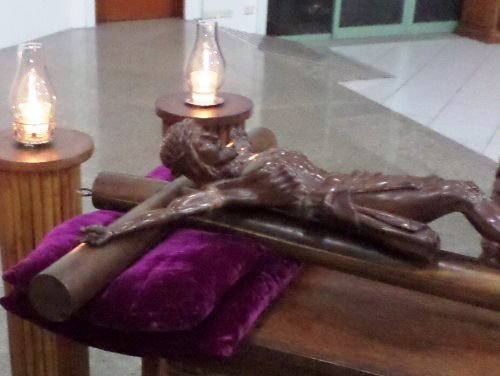
Praying with the Passion of Christ.
+ This prayer is about Jesus’ suffering not ours.
+ Jesus endured suffering and death because he loves us so deeply.
+ The chief purpose of the Passion is to draw our love to God.
+ God knows our experiences.
+ Compassion is suffering shared by those who love.
+ We see how deep into our human nature the love of God penetrates.
Fr. Joseph Tetlow, SJ
by Sr Mary Lourdes Fabia, RGS